
Estimated reading time: about 15 minutes
Key Points
- An Enforcement Unit inspection is a procedure of a criminal investigative nature, not a routine administrative inspection.
- Refusing inspectors entry constitutes a separate criminal offense of obstructing an inspector.
- The administrative fine for employing foreign workers without a permit amounts to tens of thousands of shekels per worker, and it is doubled for a repeat violation.
- An officer of a corporation bears personal criminal liability under Section 5 of the Foreign Workers Law.
- A request to cancel an administrative fine must be filed within 30 days of the date the notice was served.
- Employment through a manpower contractor does not release the service recipient from legal liability.
At eight in the morning, three investigators from the Enforcement and Foreigners Administration walk into the kitchen of a Tel Aviv restaurant, close off the back exit and demand to see identity documents from every worker washing dishes at that moment. A foreign worker employment inspection by the Enforcement Unit is a surprise inspection of an investigative nature, designed to uncover offenses under the Foreign Workers Law, and it immediately determines whether the employer will face fines of tens of thousands of shekels or personal criminal proceedings. The Authority’s inspectors do not come for a relaxed clarification meeting. They collect evidence from the moment they cross the threshold.
A wrong decision by a site manager in the first ten minutes of an inspection can turn a routine check into a serious criminal indictment against the company’s entire management.
In this situation, inexperienced conduct toward the investigators creates heavy evidentiary damage that leads to cumulative financial sanctions, the cancellation of employment permits and the forfeiture of bank guarantees deposited with the Population and Immigration Authority. This article analyzes the inspectors’ powers on site and sets out the precise legal steps that protect the employer’s rights, prevent self-incrimination and make it possible to cancel administrative fines that were imposed unlawfully.
What is a foreign worker employment inspection by the Enforcement Unit, and when does it take place?
A foreign worker employment inspection by the Enforcement Unit is a supervisory and investigative activity carried out by investigators of the Enforcement and Foreigners Administration at the Population and Immigration Authority, in order to enforce the provisions of the Foreign Workers Law, 5751-1991. The investigators act under broad supervisory powers that include entering workplaces, demanding documents, identifying workers and questioning them on site without prior notice. These inspections take place at any hour of the day or night at businesses that employ foreign labor or use contracting companies, from construction sites and restaurants to hotels, factories and farms.
Even when a business operates with lawful permits, the investigators examine whether the employer meticulously meets all the related obligations under the law. Such an inspection is not a routine administrative check but a procedure with clear criminal characteristics. Every record the investigator makes on site serves as the basis for imposing a heavy fine or for opening a criminal investigation file against the company’s owners and its active managers.
Why and when do inspectors arrive at a business?
Inspectors almost never arrive at a business by chance. Their visits rely on the authorities’ systematic detection mechanisms. Enforcement inspectors combine pre-planned operations with rapid responses to information that reaches them.
Proactive activity in sectors with high violation rates
The Population and Immigration Authority runs concentrated inspection operations in sectors it classifies as prone to violations, including restaurants, construction, agriculture and cleaning. The Authority’s computer systems routinely cross-check the employment permits issued against the actual validity of the workers’ residence visas. When the system detects that a B/1 visa has expired or that a worker’s departure was not reported, an alert is triggered that sends a team of investigators directly to the employer’s registered address.
Reports by competitors and worker complaints
Another major trigger for inspections is intelligence information and complaints submitted directly to the Authority’s Employer Investigations Department. Often this involves a labor dispute with a worker who has left, a pending wage claim, or a report initiated by a business competitor seeking to harm the company’s activity. Investigators are required to examine specific complaints, and in many cases a complaint about a single worker leads to a sweeping raid on all workers at the site without prior distinction.
What happens during the inspection in real time, step by step?
The event begins with complete surprise, intended to prevent workers from fleeing or documents from being hidden. The investigation team arrives with two to six inspectors, and they are sometimes joined by Israel Police officers to secure the premises.
Entering the workplace and demanding immediate identification
As soon as they enter, the inspectors spread out across all parts of the business, approach the workers and instruct them to stop all activity. The investigators demand that every person present show an original identity document, passport or valid residence visa. At this stage the investigators conduct a brief initial questioning in Hebrew, English or the worker’s native language, and record the employer’s details and the exact position, along with working hours and wage level. Every statement a worker makes is recorded in an action report and serves as key evidence against the employer.
Seizure of accounting records and attendance logs
While the workers are being questioned, the team leader approaches the site manager or the owner and demands to review the attendance logs, time cards and employment agreements. The inspectors have the power to seize relevant documents, photograph workstations and copy digital files related to wage payments. Every document handed to the investigators is recorded on a formal seizure form, and the site manager is required to confirm by signature the accuracy of the list of items taken.
What is checked in a foreign worker employment inspection by the Enforcement Unit?
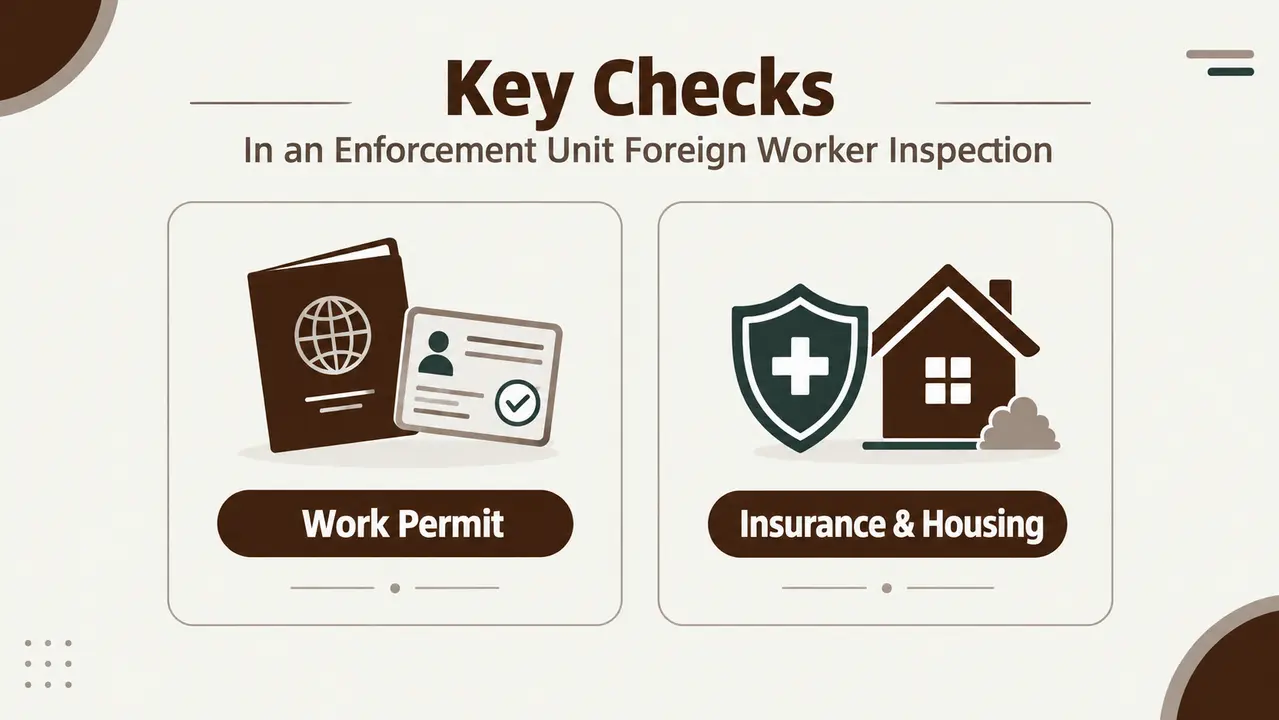
The investigators focus the inspection on two parallel legal aspects: the very legality of the stay and the work in Israel, and full compliance with the social and welfare conditions prescribed by law.
Checking that the actual work visa matches the sector
Israeli law is not satisfied with the existence of a valid residence visa. It requires a complete match between the visa and the work actually performed. The investigators check whether the worker holds a B/1 work permit registered in the name of the current employer and only within the authorized sector.
Even if the worker holds a valid visa for the construction sector, employing him in a restaurant kitchen is considered by law to be entirely unlawful employment, which gives immediate grounds for an administrative fine.
Valid private medical insurance and suitable housing
Sections 1D and 1E of the Foreign Workers Law require the employer to purchase a private health insurance policy for the worker and to provide him with suitable housing throughout the employment period. The inspectors check whether the policy covers all the treatments required under the order and whether it was paid continuously without a gap of even one day. The investigators also examine whether the housing provided includes proper sanitary conditions, a minimum sleeping area and basic equipment as defined in the regulations.
Is it permitted to refuse inspectors entry to the business?
Refusing to allow inspectors into the business is a serious mistake with immediate consequences. Section 1K of the Foreign Workers Law grants Population Authority investigators the power to enter, at any reasonable time, any place where a foreign worker is employed or where such employment is suspected. The law does not require a prior judicial warrant to enter commercial businesses, construction sites or open agricultural areas. Physically preventing entry constitutes a separate criminal offense of obstructing an inspector in the performance of his duties, and it leads to police being called in immediately, forced entry into the premises and the business managers being detained and taken to the police station.
However, the employer is entitled to require every inspector to identify himself with an official Ministry of Interior certificate of appointment before the inspection begins. It is advisable to record the inspectors’ names, badge numbers and the exact time they entered. Proper conduct is based on restrained, polite cooperation without outbursts, while preserving the business’s fundamental rights.
Which documents must be kept at the business on an ongoing basis?
Advance preparation prevents unnecessary inconsistencies between versions on site. Every employer who uses foreign workers must keep, in a dedicated binder at the business’s offices, complete and up-to-date documentation that includes a copy of each worker’s passport and valid visa, a copy of the company’s valid employment permit, and a signed employment agreement in the worker’s native language under Section 1C of the Law. The employer should also keep there a copy of the medical insurance policy confirming that coverage is valid, and computerized attendance logs detailing exact entry and exit times.
Presenting orderly documents within five minutes shortens the inspection and prevents the seizure of computers and original documents. When a site manager delays or excuses the absence of documents by claiming they are with the external accountant, the investigators record this as a failure to present documents and intensify their inspection on site.
What is the difference between a Population and Immigration Authority inspection and a Ministry of Labor inspection?
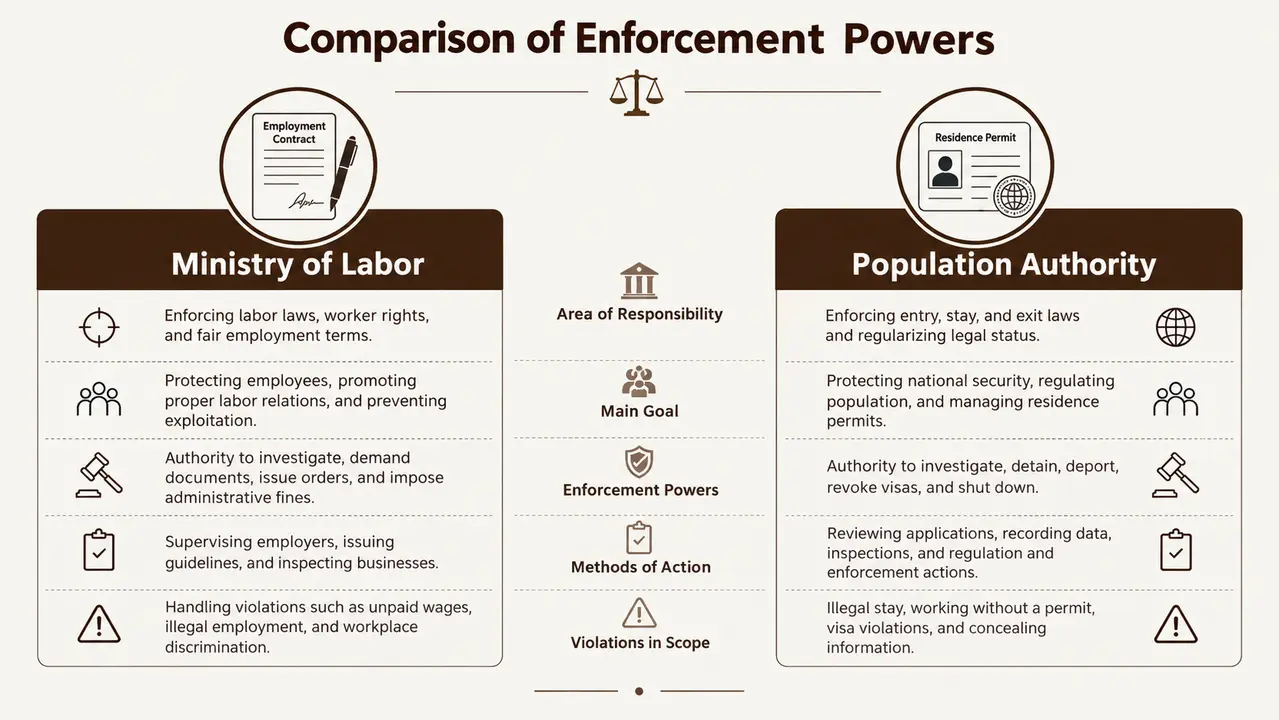
Many employers confuse inspections by Ministry of Labor inspectors with those of the Population and Immigration Authority. Inspectors of the Regulation and Enforcement Administration at the Ministry of Labor focus on general labor law under the Increased Enforcement of Labor Laws Law, 5772-2011. They check payment of minimum wage and overtime, pension contributions and vacation days for all of the business’s employees, Israelis and foreigners alike.
By contrast, investigators of the Population Authority’s Enforcement and Foreigners Administration examine the legality of the stay, work permits and the employment conditions specific to foreign workers. These are two enforcement bodies that act under different laws, each holding its own database and imposing sanctions through separate legal tracks. An inspection by one body may lead to investigation materials being passed to the other if suspicions of further violations are discovered.
What should you do when a worker does not have a valid work permit?
Discovering a worker without a valid visa during an inspection places the employer at immediate legal risk of a criminal investigation. Once the investigator announces that the worker’s visa is not valid, do not try to smuggle the worker out, hide him in a storeroom or make false factual claims. Such actions turn an administrative incident into a criminal offense of obstruction of justice. At the same time, do not give a spontaneous account in which the manager admits to knowingly employing the worker without a valid visa.
So what is the correct course of action? The manager should clarify to the investigator that the worker presented documents that appeared to be in order when he was hired, or that this is a technical error by the manpower company that has not yet been updated. He should avoid giving details beyond the worker’s basic identification and ask that the rest of the inquiry be conducted in an orderly manner at the Authority’s offices after the personal file has been reviewed.
Does employment through a manpower contractor prevent criminal liability?
Many employers mistakenly believe that contracting with a manpower contractor or an external cleaning company releases them from liability for employing workers without a visa. The labor courts and the enforcement authorities consistently reject this argument. Section 5A of the Foreign Workers Law establishes the joint liability of the service recipient when a contractor’s worker is actually employed at its premises. The State examines who supervised the work day to day, who set the working hours and who derived the direct benefit from the foreign worker’s labor.
To defend against a claim of indirect employment, the service recipient should demand from the contractor valid employment approvals, valid work permits and insurance certificates before any worker enters the site. A contract that places all liability on the contractor does not protect the manager from an administrative fine or a personal indictment if the documents were not actually checked.
How can you document the investigators’ actions without creating a confrontation?

Accurate documentation of the inspection saves many legal cases at the objection and appeal stages. The business owner or shift manager may record in writing every action taken by the investigators, including the exact time of entry and their names, the questions asked and the workers detained for questioning. It is permitted to film the investigators and the work environment, as long as you film from a reasonable distance without physically interfering with their duties. Silence on site is not an admission of guilt.
If an investigator warns that filming constitutes interference with a police officer, it is advisable to respect the instruction, stop filming and switch to writing things down by hand in an orderly log. It is especially important to document whether the investigators searched personal belongings without consent, whether the workers were denied access to water or rest, and whether documents were taken without leaving a certified copy.
What are the financial and criminal consequences of violating the law?
The Israeli legislature established a severe scale of sanctions against employers who violate the Foreign Workers Law, in order to make unlawful employment economically unviable. On the administrative track, the investigators impose administrative fines under Section 1O of the Law, amounting to tens of thousands of shekels for each individual worker employed without a permit. In the case of a repeat violation within two years, the administrative fine is automatically doubled and reaches amounts of over one hundred thousand shekels for a single worker.
In addition to the fine for the employment without a permit itself, the Authority imposes separate, cumulative fines for lack of medical insurance, failure to provide suitable housing, failure to provide a written employment contract and failure to keep payroll records. Where several workers without a visa are found at a business, the total administrative fines easily reach hundreds of thousands of shekels and put the very survival of the business at real risk.
When is a personal indictment filed against an officer of a corporation?
The most serious risk in an enforcement inspection is not limited to a fine imposed on the company. It is the filing of a personal criminal indictment against the corporation’s managers. Section 5 of the Foreign Workers Law provides that an officer of a corporation, including an active manager, partner or director, bears personal criminal liability for every offense the corporation commits under the Law. The Law creates a legal presumption that the manager knew of the offense, unless he proves that he took all reasonable measures to prevent it.
The Authority transfers cases to the criminal prosecution track when they involve the employment of several workers without a visa, repeated violations, employment under abusive conditions or obstruction of inspection procedures. A criminal conviction for these offenses carries criminal fines of hundreds of thousands of shekels, a personal criminal record, disqualification of the manager from participating in public tenders and a real risk of actual imprisonment.
Which common employer mistakes make their situation worse on site?
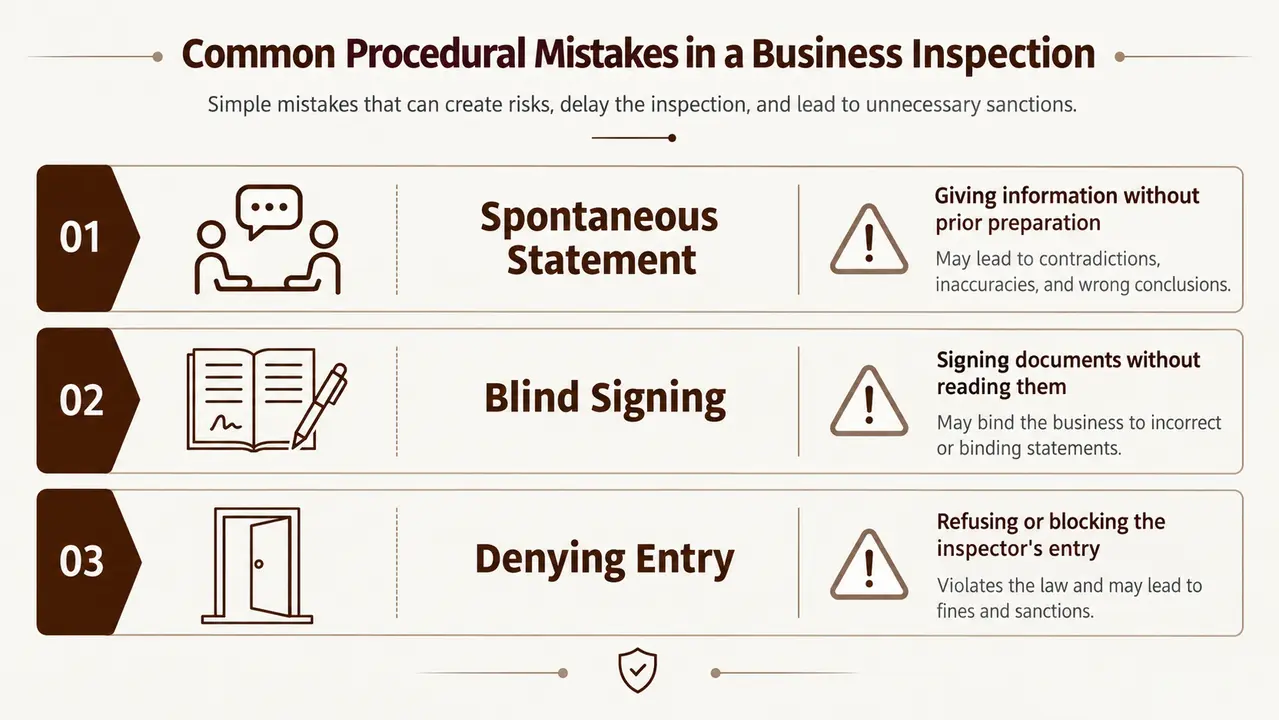
During a raid, pressure and confusion lead managers to take steps that cement their guilt in the case. The first instinct of business owners is to try to please the investigators and offer improvised explanations, such as saying that the worker came only for an unpaid trial day, or that he is a relative helping out as a volunteer. These statements are immediately recorded in the action report and amount to an explicit admission of unlawful employment, since labor law does not recognize the concept of volunteering in a commercial business.
Another critical mistake is blindly signing the inspection record at the end of the event without reading every single line. Inspectors tend to word the record so that it serves the prosecution’s position, and a manager who signs statements that were never made will find it very hard to retract them at the legal proceedings stage. If the record is inaccurate, the manager should demand that it be corrected or refuse to sign, stating the exact reason for the refusal.
What should you do the moment the investigators leave the premises?
As soon as the investigators’ vehicle pulls away from the business’s gate, a critical period of legal defense begins that determines the fate of the case. Do not wait for the fine notice to arrive in the mail, because time works against the business. The business owner should immediately gather all the managers and workers who were present, prepare a detailed memorandum of every question asked and every answer given, and keep a full backup of the security camera footage that recorded the inspection before it is automatically deleted.
The next step is to hand over all the materials for review by a lawyer specializing in population and immigration law. Early legal advice, even before the Authority’s prosecution forms its position, makes it possible to approach the Enforcement Unit and present mitigating documents in order to significantly reduce the expected fine or prevent a criminal file from being opened.
An interrogation under caution at the Employer Investigations Department and how to prepare for it
A few weeks after the on-site inspection, the business manager receives an official summons to appear for an interrogation under caution at the Population Authority’s Employer Investigations Department. This appearance is in every respect similar to a criminal interrogation at a police station. The investigator reads the manager the suspicions against him, warns him that anything he says may be used against him in court, and informs him of his right to consult a lawyer and to remain silent.
A manager who appears for an interrogation under caution without prior legal preparation almost always ends up reinforcing the prosecution’s evidence in the very first account given for the record.
The investigators use sophisticated questioning techniques, present testimony taken from the workers on site and try to draw out contradictions in the manager’s statements. Proper preparation with a lawyer allows the manager to understand his lines of defense, know which facts to emphasize and which statements to avoid, and exercise his right to consultation before answering the substantive questions.
How do you file a request to cancel an administrative fine after an inspection?
An employer who has received a notice imposing an administrative fine does not have to rush to pay the amount stated in it. Section 8 of the Administrative Offenses Law, 5746-1985, grants the employer the right to file a reasoned request to cancel the fine within thirty days of the date the notice was served. The employer also has a parallel right to file a request to stand trial before the Regional Labor Court within the same strict time frame, if he has a substantive defense.
The enforcement procedure for employers of foreign workers sets out the grounds on which a fine may be canceled or converted into an administrative warning. These grounds include material defects in the conduct of the inspection, the absence of criminal intent, good-faith reliance on misrepresentations by the worker or the manpower company, and exceptional personal or health circumstances. A request drafted to a high legal standard and supported by precise documentation leads in many cases to the full cancellation of the fine or to its reduction by tens of percent.
Comparison of enforcement tracks and legal responses for employers
To act correctly vis-à-vis the enforcement authorities, you need to distinguish between the types of violations, the level of financial exposure and the steps required to neutralize the risk. The following table maps the main characteristics of the common enforcement tracks:
How does Zari Hazan & Co. help employers in a crisis?
Managing a crisis with the Population and Immigration Authority requires unique expertise that combines in-depth knowledge of Ministry of Interior procedures with extensive experience in criminal and administrative litigation. The law firm Zari Hazan & Co. provides a complete protective framework for employers, company managers and contractors from the moment inspectors enter the business, and accompanies the company in managing contacts with the various investigative bodies.
However, turning quickly for immediate legal advice makes it possible to examine the legality of the entry order and to prevent the forfeiture of bank guarantees deposited with the Population Authority.
The firm’s team operates a rapid response system that guides site managers in real time on how to conduct themselves during an inspection, centralizes the handling of matters with the Authority’s criminal prosecution, and works to cancel administrative fines and to lawfully regularize workers’ status. With more than twenty years of hands-on experience in immigration and foreign workers law, the firm builds a tailored defense strategy that protects the manager’s good name and ensures the business continues to operate properly.
Frequently asked questions about Enforcement Unit inspections
Many employers face urgent questions when inspectors arrive. Below are focused legal answers to the most common issues that arise on site.
May an inspector confiscate a foreign worker’s passport?
The law prohibits inspectors or employers from confiscating a person’s passport. Section 376A of the Penal Law provides that unlawfully holding a passport is a criminal offense. The investigators may demand to examine the passport in order to identify the worker and check the validity of the visa, but they must return the original document to the worker immediately at the end of the check. Where deportation proceedings have been opened, the Authority is authorized to hold the passport as part of the administrative process, but only against an official written delivery receipt.
How long does it take to receive an administrative fine notice?
The time from the end of the inspection until the administrative fine payment notice arrives usually ranges from several weeks to a few months. A prolonged delay of more than a year may give grounds for canceling the fine due to unreasonable delay in the administrative authority’s conduct. Once the fine notice arrives by registered mail, a strict countdown of exactly thirty days begins for filing a reasoned request to cancel the fine or a request to stand trial before the Labor Court.
Can a criminal indictment be converted into a monetary fine?
When the Population Authority’s prosecution decides to file a criminal indictment against the employer, it is possible to conduct professional legal negotiations aimed at converting the criminal proceedings into an administrative arrangement or an agreed monetary fine. This depends on the employer’s record, the number of workers involved in the incident and the company’s willingness to remedy all the defects and regularize employment conditions immediately. Such a conversion prevents a personal criminal conviction and allows the manager to continue holding valid employment permits.
What should you do if the inspectors arrive at night?
The inspectors’ powers allow them to enter a business at any hour during which people are actually working there, including night shifts at bakeries, restaurants or continuously operating worksites. The employer must allow them in even late at night, but is entitled to ask them to wait for the responsible manager to arrive before any in-depth questioning. It is advisable to contact a lawyer immediately, in the first minutes of the night-time event, to receive precise instructions that protect the rights of those present.
How to act now to protect your business from financial collapse
Is your business ready right now to deal with a raid by Enforcement Unit investigators without being exposed to massive fines or personal indictments? Handling the enforcement authorities on your own and without expertise can seriously damage the company’s reputation and financial stability. If Population Authority inspectors have visited your business, you have been summoned for an interrogation under caution at the Employer Investigations Department, or you have received notice of an intention to impose administrative fines, do not face the legal battle alone. Contact Zari Hazan & Co. directly at 03-3851361, write to us at [email protected] or submit an urgent inquiry through the contact form for an initial legal consultation and immediate protection of your rights.
About the Author

Adv. Zari Hazan
Founding Partner
Adv. Zari Hazan is the founding partner of Zari Hazan & Co., established in 2004, which specializes in entry into Israel law, residence visas and foreign workers, administrative law and human rights. His extensive experience includes representation and advocacy before a wide range of forums, from the Appeals Tribunal to the Supreme Court.
LL.B. in Law from the Interdisciplinary Center Herzliya · Member of the Israel Bar Association since 2004 · Chair of the Israel Bar Association’s Immigration and Foreign Workers Committee · Served as a judge at the Player Status Institution of the Israel Football Association (2013 to 2024)