
Estimated reading time: 8 minutes
Key Takeaways
- A foreign expert must hold unique knowledge that is not available in the Israeli labor market and must obtain a permit from the Foreign Experts Unit of the Population and Immigration Authority.
- The mandatory wage threshold is a gross base salary equal to twice the national average wage, with no supplements and no deductions.
- The permit is granted to a specific employer only, and transferring the expert between companies requires the Authority’s prior approval.
- There is an expedited track for short assignments of up to 90 days in a calendar year.
- Employment without a valid permit is a criminal and administrative offense that exposes the employer and its managers to fines and indictments.
Table of Contents
An operations manager at an industrial plant near Ashdod faced a breakdown that halted a German-made robotic production line. The German company agreed to send a chief control engineer to resolve the problem within a week, but without a suitable permit from the Population and Immigration Authority, the professional was refused entry at Ben Gurion Airport. A foreign expert is a foreign national with essential knowledge or unique expertise that is not available in Israel, who may work in the country under a dedicated permit and a corresponding work visa.
Regularizing such status requires comprehensive administrative proof of the worker’s qualifications, together with an economic justification from the employer. When an organization tries to recruit professional staff from abroad without understanding the tracks set by law, it is exposed to serious delays in essential projects. The law firm Zari Hazan & Co. has been assisting Israeli and multinational companies in this field for more than 20 years, representing them before all the authorities.
The difference between an approved permit and a refusal depends on how the need for the expert is presented to the State. A wrong decision by company management can lead to monetary fines and criminal proceedings against officers. Below we set out the binding standards, the wage conditions and the practical steps required for the lawful employment of foreign professionals.
What Is the Legal Definition of a Foreign Expert in Israel?
The definition of a foreign expert is based on the provisions of the Foreign Workers Law and the administrative arrangements of the Ministry of Interior. It refers to a worker who is not an Israeli citizen or resident and who holds rare skills in technology, science, senior management or engineering. This status does not arise automatically; it requires a special permit from the Foreign Experts Unit of the Population and Immigration Authority.
The normative basis for this employment is anchored in Population Authority Procedure 5.3.0041 and in the broader framework of the Entry into Israel Law. The State examines every application with great care, out of a desire to protect the jobs of Israeli citizens. Only a worker who meets proven expertise tests and is paid in accordance with the regulations will be recognized under this classification.
Even if the company urgently needs the worker, it may not put them to work before the process has been fully completed. Employment without a permit is a clear violation of immigration law.
Who Is a Foreign Expert and How Is the Uniqueness of Their Knowledge Assessed?
The central question before the unit is who actually qualifies as a foreign expert and what sets them apart. A worker will be considered one when they hold unique knowledge, accumulated professional experience or a specific certification that is not available in the local labor market. It is not enough that the worker is talented or hardworking, since the employer must show that the skills are essential to the company’s operations.
Authority officials review the application file and examine certificates, résumés and recommendations from previous employers. The employer must then present a detailed job description illustrating the link between the candidate’s education and the intended assignment. When a company imports cutting-edge technology that is not taught at institutions in Israel, this argument carries great weight in the committee’s decision.
Proving Exclusive Knowledge in Complex Technology Projects
In complex engineering projects, many companies need to bring in system designers with specific experience. The employer attaches professional opinions explaining why local staff are unable to operate the equipment. Experience shows that generic documents lead to a quick rejection of the application.
But when official certification documents from the system manufacturer are presented, the Experts Unit tends to be persuaded of the need for the employment. Accuracy in the technical details is what distinguishes an application that is approved from one that is rejected outright.
The Difference Between a Foreign Expert and a Foreign Worker in Economic Sectors
There are legal, economic and administrative differences between a foreign expert and a general foreign worker. General foreign workers are employed in traditional sectors such as construction, agriculture, caregiving or hospitality. These sectors operate on the basis of bilateral agreements between countries and government quotas set in advance. The foreign experts track, by contrast, is open to all sectors of the economy and includes high-tech companies, industrial plants, research institutions and international consulting firms.
A general worker is sometimes employed through licensed manpower corporations, whereas a foreign expert is tied directly to the specific Israeli employer. This tie is personal and binding, so the worker may not work for any other company.
Differences in Quotas and Permitted Employment Sectors
While the employment of general workers is limited by rigid annual quotas, a foreign expert visa does not depend on a numerical quota but on the quality of the expertise. The employer does not compete with other companies in the same sector for an allocation of workers. Instead, it must prove that it tried to find an Israeli worker through job advertisements and approaches to placement agencies.
The failure to find a local alternative is a precondition for considering the application. The regulator verifies that the company made a reasonable effort before turning to the international talent pool.
Legal Status and the B/1 Work Visa
Both types of workers hold a B/1 residence and work visa, but the license conditions are entirely different. For a regular foreign worker the license is limited to a particular sector, while an expert’s license expressly states the name of the employing company and the exact position. A change in the expert’s position without the Authority’s prior approval invalidates the license.
The responsibility placed on the employer in the experts track is also much heavier. The employer bears full responsibility for ongoing reporting, meeting the wage threshold and the worker’s housing throughout their stay in Israel.
What Are the Criteria for Recognition as a Foreign Expert?
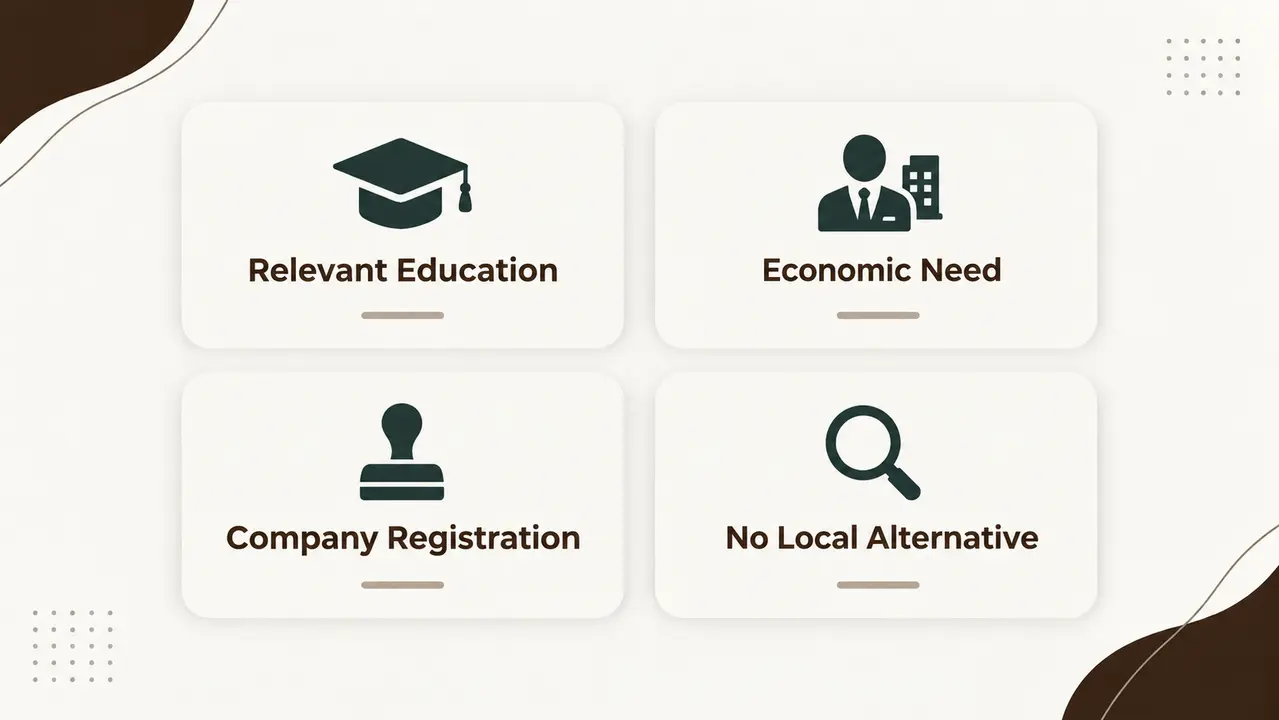
The Population and Immigration Authority has set a series of criteria for foreign experts designed to filter out applications that do not meet the required professional standard. The first criterion is a complete match between the worker’s education and the role they are expected to fill at the Israeli company. The second criterion concerns the company’s economic or operational need to employ them, examining the worker’s impact on the continuation of business activity.
In addition to the candidate’s personal conditions, the Authority examines the employer itself. A company applying for a permit must be a duly registered corporation in Israel, free of fee debts and with no criminal or administrative record in the field of labor law. Companies in liquidation proceedings or that have violated workers’ rights in the past will face immediate refusal.
Academic Degree Requirement Versus Practical Experience
As a rule, the procedures require an academic degree from a recognized institution abroad in the relevant field. A civil engineer, data scientist or financial manager will be required to present official certificates and verified transcripts. However, there are technological professions in which practical experience outweighs a formal certificate.
In such cases, our firm presents evidence of many years of seniority, professional certifications and proven projects. The Authority may approve the application if it is convinced that the practical experience compensates for the lack of a degree.
The Mandatory Wage Requirement, Double the Average Wage for Experts and How It Applies
The central and strictest requirement for employing professionals from abroad is paying twice the national average wage. The regulator determined that an employer cannot bring a foreign expert at a regular salary, in order to prevent the import of cheap labor at the expense of Israeli workers. The high wage threshold serves as a kind of economic filter that ensures the company truly needs exceptional knowledge and can afford to pay for it.
The required wage is a gross base salary, excluding overtime supplements or various expense reimbursements. Any shortfall below this threshold is direct grounds for revoking the permit and for administrative sanctions.
How the Wage Is Calculated Based on National Insurance Data
The determining amount is updated every year according to the national average wage data published by the National Insurance Institute. In 2024 the average wage was high enough for the foreign expert threshold to exceed 25,000 shekels gross per month. The employer must follow National Insurance publications and update the salary in the contract on an ongoing basis.
Even if the contract was signed at the beginning of the year, increases in the index and the average wage require an immediate adjustment of the pay slip. Failing to pay attention to this update may place the employer in breach of the permit conditions.
Mandatory Israeli Bank Account and Prohibition on Deductions
The Population Authority procedure sets an unequivocal rule requiring the salary to be paid directly into an Israeli bank account opened in the expert’s name. Transferring the salary to a foreign account in the country of origin or paying in cash is strictly prohibited. The Authority requires bank statements and transfer confirmations to be submitted with every permit extension request.
Deductions for rent or living expenses are also prohibited if they reduce the base salary below the double threshold. The protected wage must reach the worker in full.
A Practical Scenario: Bringing a Foreign Mechanical Engineer to Install a Production Line
An industrial plant in the Sha’ar HaNegev industrial zone purchased a complex cooling system from Italy worth 4 million euros. Assembling and calibrating the system required an Italian mechanical engineer with 10 years of specific experience with that model. The Israeli company signed an employment contract with the engineer for a period of 8 months at a high gross monthly salary.
The plant submitted an application to the Experts Unit, attaching engineering drawings, the engineer’s degree certificate and a letter explaining that the line shutdown was causing heavy damage every day. The application was approved within 25 business days, and the expert received an entry visa that was converted into a B/1 license in Israel. In this case, accuracy in presenting the facts and compliance with the wage conditions prevented a delay in launching the plant.
How Does the Process with the Population and Immigration Authority Work?
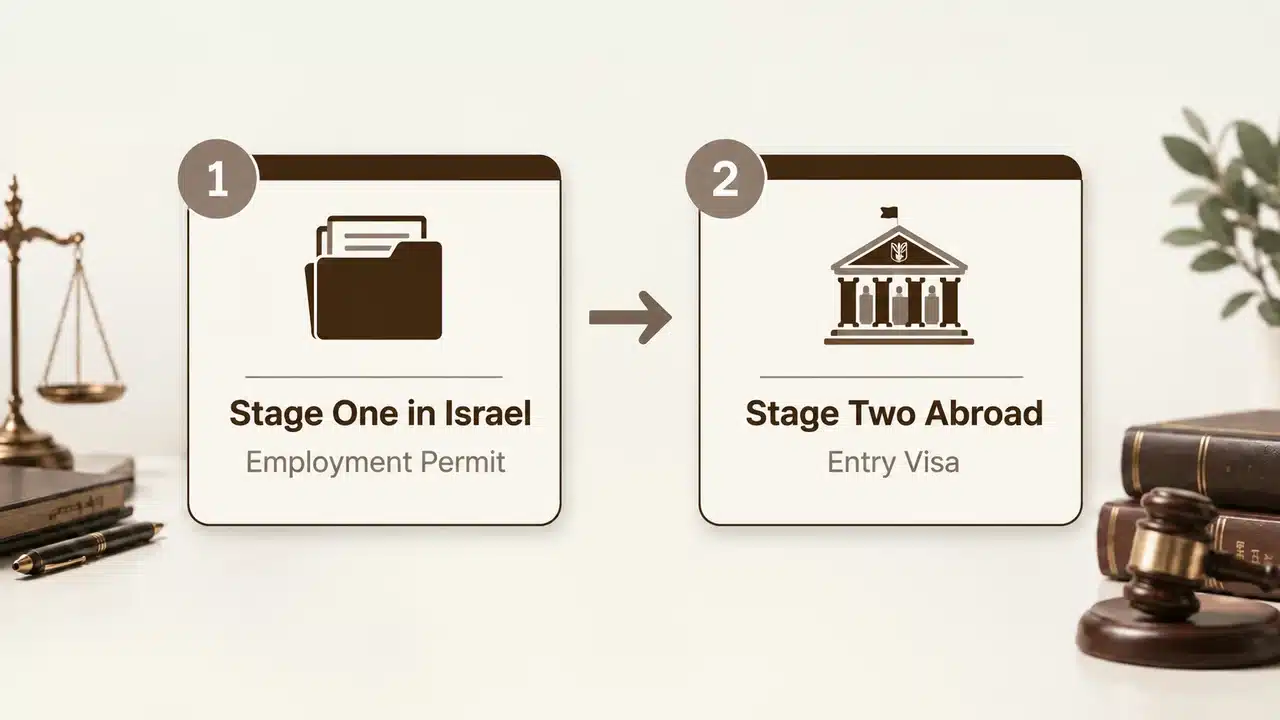
Regularizing the status of a foreign expert is a structured two-stage administrative process. The first stage takes place entirely in Israel, when the employer submits an online application to the Foreign Experts Unit of the Population Authority. The application includes detailed forms, fee payment confirmations, an explanatory letter and the candidate’s professional documents.
The Authority’s experts committee reviews the file and verifies compliance with all threshold conditions. Detailed information on how to submit the application and on the fees appears on the foreign experts employment page of the government website. Approval of the application grants the employer an employment permit for a predetermined period.
Issuing an Entry Visa at the Consulate and Obtaining a B/1 License in Israel
After the employment permit is received in Israel, the second stage begins, which concerns the worker abroad. The Population Authority sends an authorization cable to the Israeli consulate in the expert’s country of origin. The candidate is invited to the diplomatic mission and presents a valid passport, a certificate of good conduct, medical tests and confirmation of the absence of infectious diseases.
The consulate stamps a temporary B/1 entry visa in the passport, valid for 30 days only. Upon landing at Ben Gurion Airport, the employer must arrange a residence and work license sticker for the worker at a Population Administration office, for the full period approved in the permit.
The Foreign Expert Track for Short Assignments of Up to 90 Days
Many companies do not need an expert for a full year, but rather for an urgent, short assignment such as repairing a fault, training teams or implementing a software version. For these cases there is a special procedure allowing a foreign expert to be brought in for up to 90 days in a calendar year. The advantage of this track is an expedited review process that is sometimes completed within a few days.
But the shortened track does not exempt the employer from the duty of professional proof or from paying the appropriate fees. The expert must leave Israel at the end of the approved period, with no possibility of extension under the same expedited procedure.
Common Mistakes in Expert Permit Applications
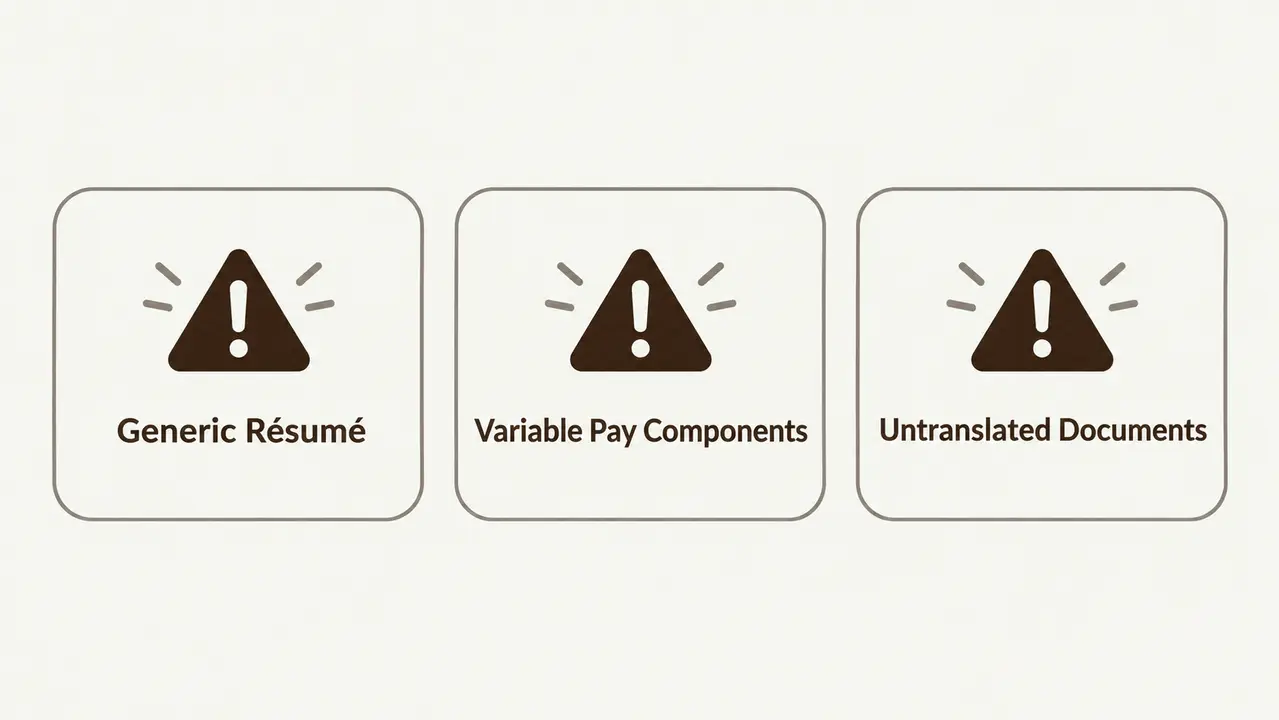
Many employers err when they submit generic résumés that do not highlight the specific expertise required for the position. Another common mistake is including variable pay components such as bonuses or commissions to reach the double average wage threshold. The Population Authority rejects these calculations and requires a fixed base salary.
In addition, submitting documents in foreign languages without a notarized translation into Hebrew or English delays processing by many months. Working with an experienced law firm prevents these failures in advance and ensures a proper submission in the very first round.
What Are the Legal Consequences of Employment Without a Lawful Permit?
Employing a foreign expert without a valid work permit is a serious criminal and administrative offense under the Foreign Workers Law. Inspectors of the Population and Immigration Authority conduct surprise inspections at offices, construction sites and factories throughout the country. An employer caught employing a foreign worker without a visa faces administrative fines of tens of thousands of shekels per worker.
Beyond the monetary fines, the prosecution authorities commonly file personal criminal indictments against company managers. A manager’s criminal conviction may impair their ability to manage corporations and prevent the company from participating in public tenders. The worker themselves may be detained and removed from Israel, with entry barred for many years.
What to Do When the Population Authority Issues a Refusal
When the Experts Unit rejects a permit application, the employer receives a reasoned refusal letter. There is a legal right to file an internal appeal with the supervisor at the Population Authority within 21 days of receiving the decision. In the appeal, one must point to errors in the assessment of the facts or bring supplementary evidence proving the need for the expert.
If the internal appeal is rejected, the employer may file an administrative appeal with the Appeals Tribunal under the Entry into Israel Law. The Tribunal examines whether the Authority’s decision was reasonable and proportionate and, in appropriate cases, orders the file returned for reconsideration.
Comparison of Foreign Expert Employment Tracks in Israel
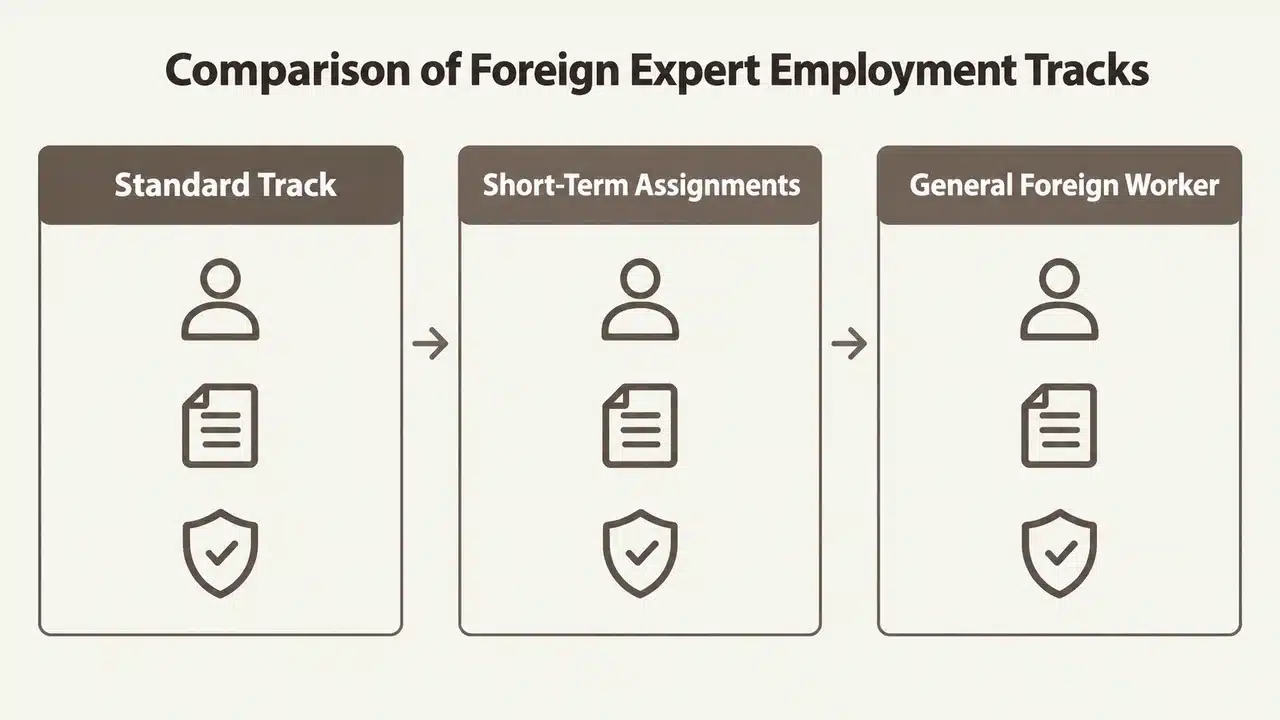
The following table presents the main features of the different tracks, to help employers choose the track that suits their business needs.
Choosing the wrong track may delay the worker’s arrival. Correctly defining the project duration avoids unnecessarily complex applications.
Legal Solutions for Employers Bringing Foreign Experts
Bringing professional staff from abroad involves bureaucratic complexity that requires advance planning. The following table illustrates how experienced legal handling resolves the company’s operational needs before the authorities in Israel.
Our firm accompanies corporations through every stage of the process to ensure continuous work free of legal problems. The firm’s accumulated experience makes it possible to identify obstacles even before the application is filed.
Frequently Asked Questions About Employing Foreign Experts in Israel
Can a foreign expert be employed without an academic degree?
The regulatory rule requires an academic degree from a recognized institution abroad that is relevant to the position. However, in unique professions where knowledge is acquired through practical work, an exemption from the degree requirement can be requested. The employer must present substantial proof of at least 5 years of seniority and comprehensive professional certificates.
May the foreign expert’s family members work in Israel?
A spouse and children up to age 18 may join the expert under an accompanying B/2 residence visa. This visa grants the right to live in Israel but does not give the spouse an automatic work permit. To work in Israel, the spouse will need to obtain a separate, independent work permit under the Population Authority’s procedures.
How far in advance should an employment permit extension be filed?
It is recommended to file the permit extension request at least 60 days before the permit’s expiry date. Late filing may leave the worker without a valid visa, leading to a forced work stoppage. In addition, the extension request must include bank statements showing payment of the full required salary during the past year.
May a foreign expert be transferred between companies in the same group?
A foreign expert’s employment permit belongs to the specific employer named in the application and cannot be transferred automatically. Even in the case of subsidiaries or sister companies within the same business group, it is prohibited to employ the expert at another legal entity. Such a transfer requires filing a formal request to update the permit conditions and obtaining the Population Authority’s prior approval.
What is the maximum validity of a foreign expert permit in Israel?
A foreign expert employment permit is valid for up to one year at a time. The Authority allows the permit to be extended every year up to a maximum cumulative period of 5 years in total. An extension beyond 5 years is considered highly exceptional and requires the approval of the Minister of Interior for special reasons.
How to Choose Professional Legal Support for Foreign Expert Visas
Dealing with the Ministry of Interior’s Experts Unit requires up-to-date legal knowledge and a deep understanding of Israeli immigration law. An error in defining the position or failure to meet payment conditions may lead to rejection of the application and cause financial damage to the company. An employer that acts correctly chooses a law firm that specializes exclusively in visas and entry into Israel.
The law firm Zari Hazan & Co. has been operating for more than 20 years and provides comprehensive legal support, from the candidate assessment stage to receipt of the final visa in the passport. The firm’s team continues to assist the employer with adjusting pay slips and lawfully extending residence licenses after the worker lands.
Are you planning to bring a professional expert from abroad and need a quick feasibility check against the legal requirements? Zari Hazan & Co. invites you to schedule an initial legal consultation. Contact us through the contact page on the firm’s website, call us directly at 03-3851361, or e-mail [email protected]. We will be happy to assist you at our office at 150 Menachem Begin Road, Tel Aviv.
About the Author

Adv. Zari Hazan
Founding Partner
Adv. Zari Hazan is a founding partner of Zari Hazan & Co., established in 2004 and specializing in Israeli entry law, residence visas and foreign workers, administrative law and human rights. His extensive experience includes representation and advocacy before a wide range of forums, from the Appeals Tribunal to the Supreme Court.
LL.B. from the Interdisciplinary Center Herzliya · Member of the Israel Bar Association since 2004 · Chair of the Immigration and Foreign Workers Committee of the Israel Bar Association · Served as a judge at the Player Status Institution of the Israel Football Association (2013 to 2024)